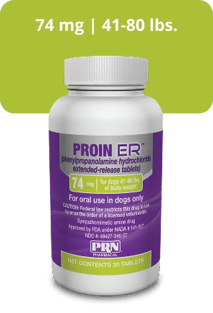
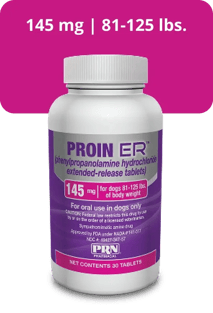
proin-er-family-1
PROIN-ER-Horiz-Logo-purple

PROIN ER is the only FDA-approved once-daily medication for the control of canine urinary incontinence (UI) due too urethral sphincter hypotonus.

Indication
PROIN ER is indicated for the control of urinary incontinence due to urethral sphincter hypotonus in dogs.

Available as For use with Strengths
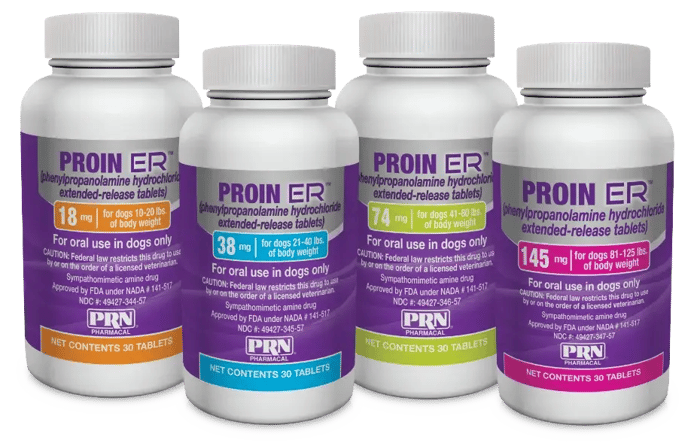
Tablet Canines 18, 38, 74 or 145 mg tablet


Benefits

firstline-icon

A First-Line UI Treatment Per ACVIM Consensus1

PROIN ER is indicated for the control of canine UI due to urethral sphincter hypotonus.

Group-164

Treatment Compliance

Simple once-daily dosing helps clients adhere to treatment, which can improve patient outcomes.1


Group-165

Cost-Effective

Lower cost of treatment can make quality care more accessible and offer long-term affordability for pet owners.


Group-166

Consistent Control

Patented extended-release technology provides controlled delivery that ensures steady absorption, reducing the occurrence of UI episodes.


Group-167

Broad Tolerability

Formulated with hydrolyzed protein, making it an alternative for dogs with dietary sensitivities.*


Precautions

PROIN ER may cause hypertension; therefore, use with caution in dogs with pre-existing heart disease, hypertension, liver disease, kidney insufficiency, diabetes, glaucoma, and conditions with a predilection for hypertension.

Use caution in dogs receiving sympathomimetic drugs, tricyclic antidepressants, or monoamine oxidase inhibitors as increased toxicity may result. Use with caution in dogs administered halogenated gaseous anesthetics as this may increase the risk of cardiac arrhythmias.

About PROIN ER

About Canine UI

Resources 

PROIN ER Detailer

Educate your team about canine UI and PROIN ER.

PROIN ER Pet Owner Brochure

Teach your clients about UI and how PROIN ER can help.

References

1Kendall A, Byron JK, Westropp JL, Coates JR, Vaden S, Adin C, Oetelaar G, Bartges JW, Foster JD, Adams LG, Olby N, Berent A. ACVIM consensus statement on diagnosis and management of 
 urinary incontinence in dogs. J Vet Intern Med. 2024 Mar-Apr;38(2):878-903. doi: 10.1111/jvim.16975. Epub 2024 Jan 13. PMID: 38217372; PMCID: PMC10937496.

2Barter LS et al. 2015; Adams VJ et al. J Small Anim Pract. 2005.

3Richter K.P., Ling G.V. Clinical response and urethral pressure profile changes after phenylpropanolamine in dogs with primary sphincter incompetence. JAVMA, Vol. 187, No 6, September 15, 
 1985. 605-611.

4Scott, L., Leddy M. and Bernay, F. Evaluation of phenylpropanolamine in the treatment of urethral sphincter mechanism incompetence in the bitch. J. Small Anim. Pract. 2002;43(11): 493-6.

5Noel, S., et al. Combined pharmacokinetic and urodynamic study of the effects of oral administration of phenylpropanolamine in female Beagle dogs. Vet. Journal, 2010; 184(2): 201-207.

6Pegasus Laboratories, Inc. (2019). Freedom of Information (FOI) Summary for PROIN ER (phenylpropanolamine hydrochloride extended-release tablets) Dogs: U.S., (NADA 141-517). Center 
 for Veterinary Medicine (CVM).

7Kynetec 2022 Urinary Incontinence in Canine Survey.

8Consumer Dog Owner survey conducted by PRN Pharmacal, December 2022.

9FDA-CVM FOI Summary, PROIN ER, NADA 141-517 (March 29, 2019)

10Byron JK, Taylor KH, Phillips GS, Stahl MS. Urethral Sphincter Mechanism Incompetence in 163 Neutered Female Dogs: Diagnosis, Treatment, and Relationship of Weight and Age at Neuter to Development of Disease. J Vet Intern Med 2017;31:442–448.

*While hydrolyzed proteins reduce the risk of immunologic reactivity, individual sensitivities may still occur.